Do Market Research Before You Build an App (Competitors, Pricing, Revenue)
Before you build an app, look at similar products, what they charge and how they make money. A simple five-step research process you can do alone, plus how to get it done with AI in about a minute.
· 6 min read
Key takeaways
- The point of market research isn't a report. It's deciding what to include, what to cut and what to charge.
- Three to five similar products, with their pricing, features and customer complaints, are usually enough to set direction.
- Your revenue model (online checkout, pay in person, subscription, commission) changes which screens you need, so settle it before you build.
- For internal tools, compare against software you could buy instead of building.
- fingr can run AI market research before you pick features and feed the results straight into your feature list and pricing model.
Why research comes before building
When you get excited about an app idea, a feature list shows up first: bookings, reminders, reviews, loyalty points. What you don't know yet is whether customers want those things, or whether someone already does them better.
Skip the research and you risk:
- Building a copy of something people already use for free, so nobody has a reason to switch.
- Pricing far above or below what the market expects, so either nobody signs up or there's no margin left.
- Missing the thing customers actually complain about while spending weeks on features nobody asked for.
Research catches all three before you've spent anything on building. We cover why this order matters in How to build a web app efficiently.
A five-step research process you can do yourself
1. Find three to five similar products
Search the way your customers would: "booking app for dog groomers," "catering order software." Check the App Store, Google Play, Reddit threads and review sites like G2 or Capterra. Also write down what customers use today instead: spreadsheets, text messages, a paper notebook. That's competition too.
2. Map out pricing
Put each product's pricing in a table.
| What to look at | Examples |
|---|---|
| How they charge | Monthly subscription, per-transaction fee, one-time purchase, free with ads |
| Price range | Cheapest plan and the plan most people pick |
| What's free | Trial length, free plan limits |
| How plans are split | Number of staff, number of bookings, features |
That one table shows you the floor and the ceiling for your own price.
3. Note what they promise
The big headline on each homepage tells you what each company thinks matters most. If every competitor leads with "easy," leading with "easy" won't make you stand out.
4. Collect customer complaints
One- to three-star reviews on the App Store, G2 or Capterra are the most valuable research you'll find. If "it gets messy with more than one staff member" or "the fees are too high" keeps coming up, that's your opening.
5. Decide how you'll make money
This decision changes your screens more than anything else.
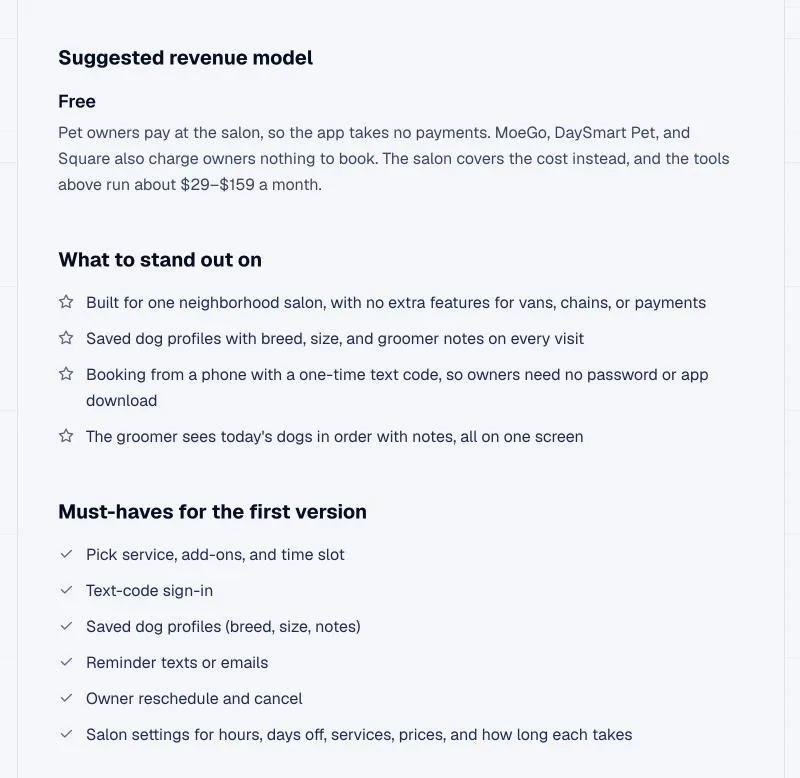
- Online checkout: you need a payment page, order history, a refund policy and a payment provider such as Stripe.
- Pay in person or by invoice: no checkout screens. You just take bookings or orders.
- Monthly subscription: you need a plans page, recurring billing and a way to cancel.
- No revenue (internal tool): skip payments. Staff invites and permissions matter instead.
Example: a dog grooming booking app
Here's how research changes real decisions. The original idea: "customers book a grooming slot and pay by card in the app."
- Looking at similar products: big booking marketplaces already win new customers through map search and reviews. Competing on new-customer discovery wasn't realistic.
- Reading reviews: two complaints kept coming up. "Prices depend on breed and weight, so I never know the final cost when I book," and "I can't remember which cut we got last time."
- Checking how the industry gets paid: most groomers charge in person after the appointment, because the price depends on the coat's condition.
So the plan changed. Instead of chasing new customers, focus on keeping regulars. Drop in-app card payments in favor of an estimated price plus pay at pickup. Add a grooming history for each dog (photos and style notes). Three payment screens disappeared, one feature customers actually wanted showed up, and since nothing had been built yet, the change cost nothing.
Building an internal tool? Compare against what you could buy
An app for your own team has no competitors, but it does have alternatives: off-the-shelf scheduling, inventory or CRM software. The real question is "why not just buy one?"
- What does the off-the-shelf tool cost per month? Does the price grow with every seat?
- Where does it clash with how your team actually works?
- Is that gap big enough to justify building your own?
Answer those and you'll know whether to build, and what to focus on if you do.
With fingr: AI market research in about a minute
fingr builds this research into the app-making flow.
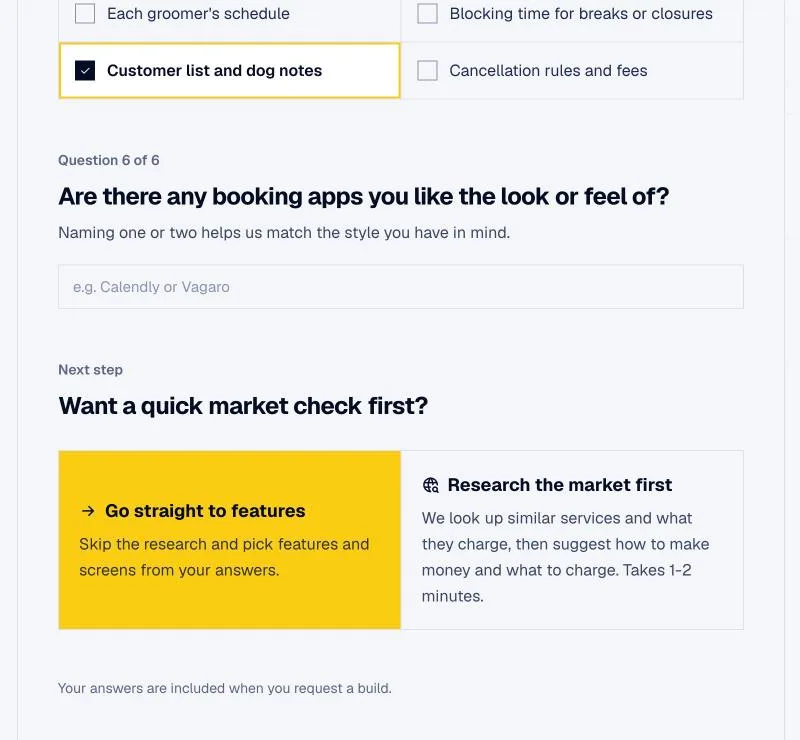
- Describe the app you want in a sentence or two.
- Answer a few questions, including who it's for (your team, your customers, or anyone) and how it makes money.
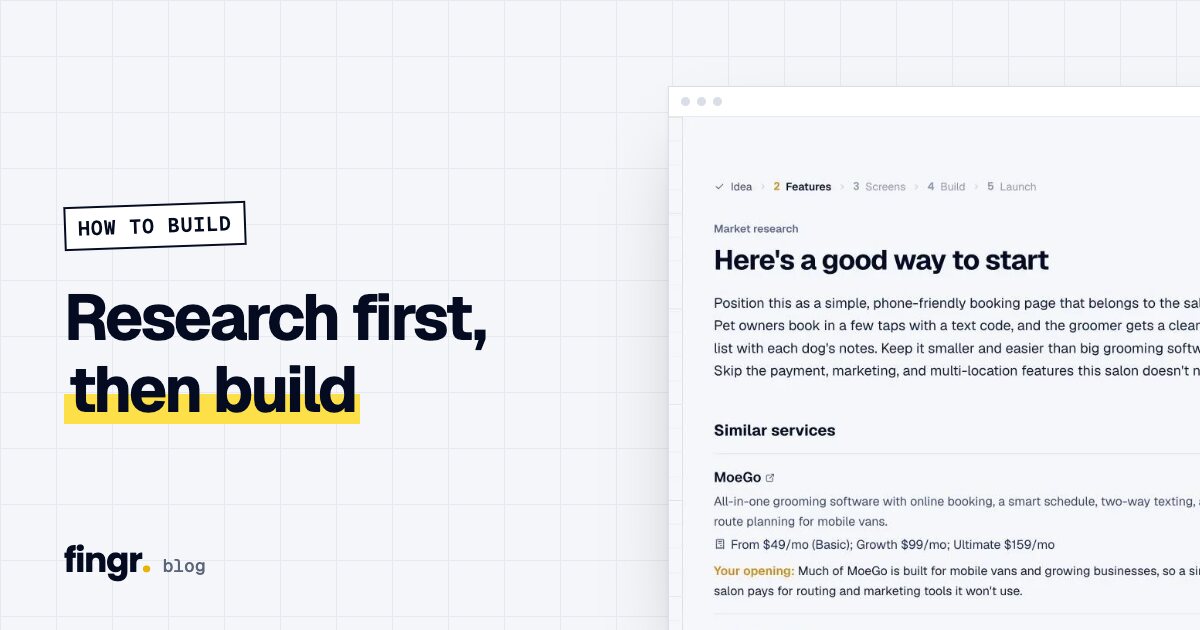
- Choose to get market research first. An AI searches the web and writes up what it finds, usually in about a minute.
You get:
- Similar products and what they charge
- A suggested revenue model and plan structure
- What you could stand out on
- Must-have features and things to watch out for
- Links to the sources it used
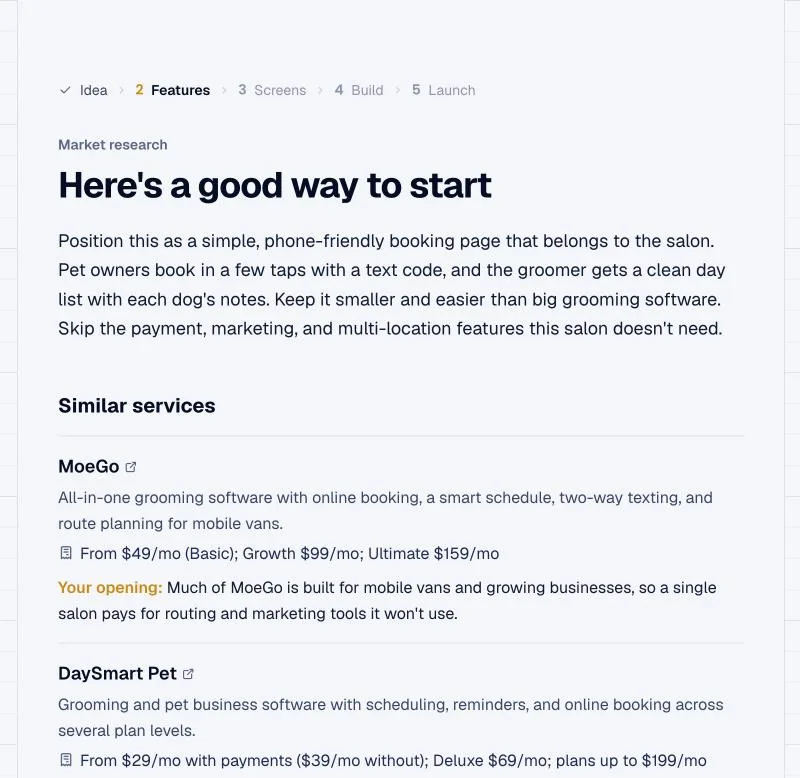
If you're working in English, the research looks at the US market with dollar pricing. If you said the app is for internal use, the results are framed as "tools you could buy today" and "where they fall short for your team."
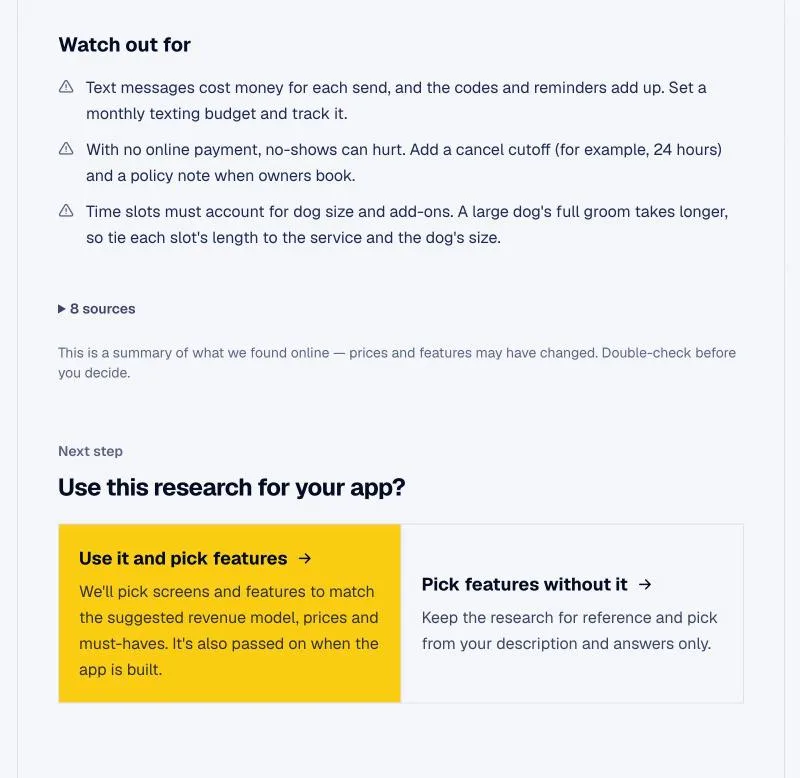
When you click "Apply and pick features," the findings flow straight into the suggested features and pricing model. If the research says customers in your industry usually pay in person, for example, the plan comes out without an in-app checkout. Research, features, screens and the finished app stay connected.
Know the limits of AI research
Treat AI research as a starting point. It's built on public web information, so a few things deserve a second look:
- Prices change often. Before a big decision, check each product's official pricing page.
- AI doesn't know your neighborhood or your regulars. A quick conversation with five actual customers beats any summary.
- Take market-size numbers lightly. For a small business app, "will my customers use this?" matters far more than total market size.
When another approach fits better
- You need an investor-grade market report. Deep analysis of market size, growth and competitive dynamics is a job for a research firm or consultant. fingr's research is practical: it helps you decide what to build.
- You already know your industry well. Research is optional. Skip straight to picking features.
Once the research has set your direction, the next step is the screens. Read Screens before code to see why designing first cuts revision costs.
Try it
Describe the app you want, answer a few questions and choose to get market research first. You'll see similar products, their pricing and where you can stand out before you pick a single feature. You can build one app with free credits. Start with your idea.
FAQ
Does a small business app really need market research?
Yes, but not a big report. Looking at three to five similar products, their pricing, features and customer complaints is enough to decide what to include, what to skip and what to charge.
What should I look at during market research?
Similar products, what they charge and how their plans are structured, what they promise on their homepage, what their customers complain about, and how you'll make money.
Is research useful for an internal tool my team will use?
Yes. Instead of competitors, compare against tools you could buy today and note what they get wrong for your team. That tells you whether to build at all and what to focus on.
How does fingr's market research work?
After you describe your idea and answer a few questions, choose to get market research first. An AI searches the web and summarizes similar products, pricing, a suggested revenue model, must-have features and risks. It usually takes about a minute.
Start your app with one sentence
Answer a few questions, see the screens first, then turn them into a real app. You can build one app with free credits.